Loading
Episode
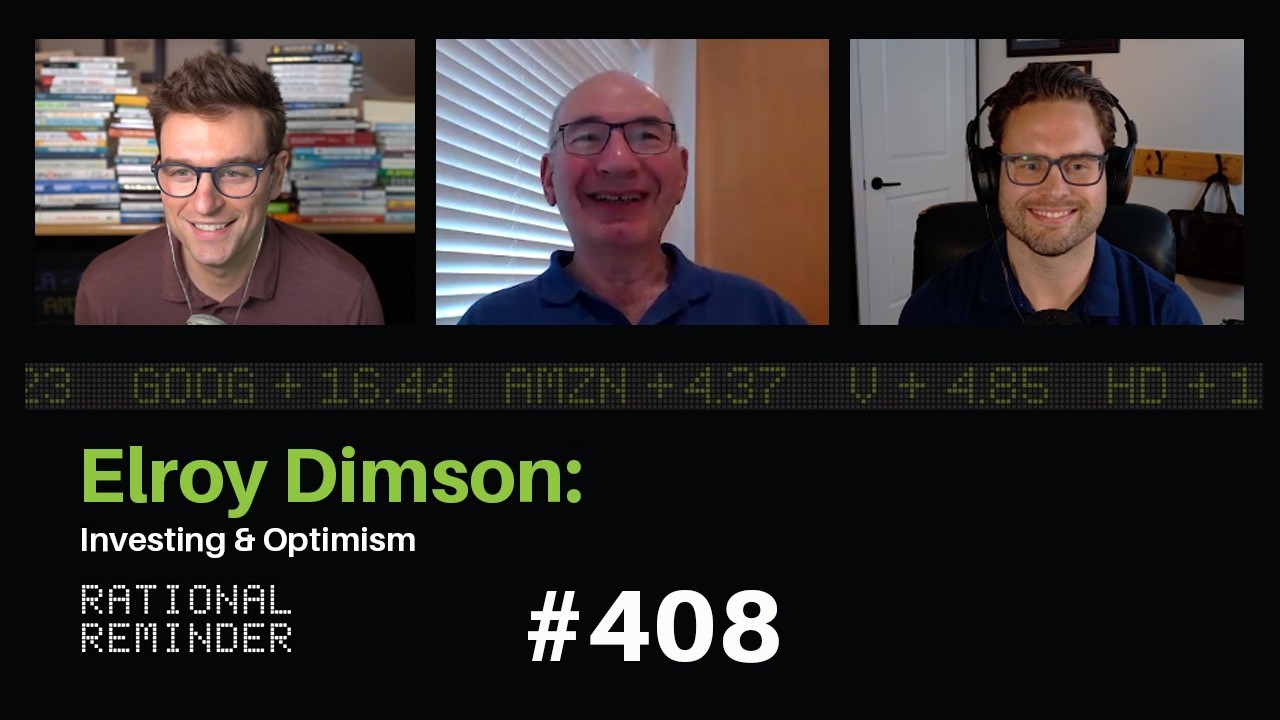
Elroy Dimson: Investing & Optimism | Rational Reminder 408
Views
7K
0.9× the show's usual
Length
1h 32m
usual ~1h 11m
From the show
Description
Meet with PWL Capital: https://pages.pwlcapital.com/en-ca/contact-us?utm_source=content&utm_medium=youtube&utm_campaign=rationalreminder_yt Avoid Online Scams https://pwlcapital.com/stay-safe-online/ Ben Felix or any PWL employee will never reach out to you on social media platforms or WhatsApp to give financial advice. These are scammers trying to commit fraud. In this episode, we are joined by Elroy Dimson, Professor of Finance at Cambridge Judge Business School and co-creator of the Dimson-Marsh-Staunton (DMS) dataset, for a sweeping and deeply insightful conversation on financial history, market behavior, and the evolution of global investing. Elroy walks us through the origins of the groundbreaking Triumph of the Optimists, the challenges of assembling over 100 years of global return data, and the critical biases that once shaped our understanding of markets. We explore how expanding beyond U.S.-centric data reshaped expectations for the equity risk premium, why economic growth doesn’t necessarily translate into higher stock returns, and what history reveals about diversification, factor investing, and investor behavior. Elroy also shares lessons from his work with major institutions like Norway’s sovereign wealth fund, discusses the surprising long-term outperformance of railways, and offers a grounded perspective on future expected returns. This episode is a masterclass in using history to inform better financial decisions. Timestamps: 0:00:00 Intro 0:06:09 Why it's important to study financial market history when thinking about the future 0:06:32 What the process was like to assemble the data for Elroy's 2002 book "Triumph of the Optimists" 0:13:41 What some of the biases and other issues that can affect historical index data are 0:18:35 How including markets that didn’t survive or succeed affects global average stock returns 0:22:13 How Elroy's work on long-term global returns changed our understanding of expected stock and bond returns 0:28:56 How the composition of country weights changed between 1900 and today 0:35:31 What the historical relationship between a country’s economic growth and its stock returns is 0:40:58 The historical relationship between industry growth and stock returns 0:43:48 The impact global diversification has had on long-term risk and returns 0:47:36 The effect frictions - like foreign markets being less accessible to investors historically than they are today - could have on the diversification benefits seen in the data 0:51:47 Why investors continue to exhibit home country bias when the benefits of international diversification are so well known 0:58:24 How important industry diversification is relative to country diversification 1:01:09 How pervasive the size and value effects have been in historical data around the world 1:06:39 Whether the size and value premiums are still worth pursuing today 1:10:45 What history tells us about the size of the equity risk premium 1:20:16 Looking at markets today, with wars, high valuations, etc, Elroy describes how investors should remain optimistic 1:23:54 How Elroy thinks about the role of bonds in portfolios 1:26:20 How investors should think about expected future returns 1:27:41 Elroy defines success in his life Papers From Today's Episode: https://zbib.org/fbe2c628ea2645da8cb4ea8509c66390 Links From Today’s Episode: Rational Reminder on iTunes — https://itunes.apple.com/ca/podcast/the-rational-reminder-podcast/id1426530582. Rational Reminder on Instagram — https://www.instagram.com/rationalreminder/ Rational Reminder on YouTube — https://www.youtube.com/channel/ Benjamin Felix — https://pwlcapital.com/our-team/ Benjamin on X — https://x.com/benjaminfelix Benjamin on LinkedIn — https://www.linkedin.com/in/benjaminwfelix/ Benjamin Warwick on LinkedIn - https://www.linkedin.com/in/braden-warwick-a40b48a3
Covered · Topics
What was discussed
Related
More with these guests
Related
Talks about similar things

The Golden Age of Returns is Over
Making Money PodcastSep 15, 2025
89% similar
39K views
David Booth: ‘The Markets Work Well for Everybody, Not Just the Insiders’
Morningstar, Inc.Sep 1, 2026
87% similar
5K views
Stocks for the Long Run...? (plus Reading Habits w/ Mark Sutcliffe) | Rational Reminder 211
The Rational Reminder PodcastJul 28, 2022
88% similar
6K views
Lessons from The Wealthy Barber (2025) | Rational Reminder 387
The Rational Reminder PodcastDec 11, 2025
87% similar
10K views
Billionaire's WARNING: I'm SELLING. The Crash Is Already Here!
The Diary of a CEOJun 25, 2026
85% similar
9.7M views
The Long View: Daniel Rasmussen: ‘Be Very Wary of Illiquid Asset Classes’
Morningstar, Inc.May 7, 2025
86% similar
4K views