Loading

Episode
How the U.S. Stacks Up to China’s ‘Engineering State’ | WSJ's Bold Names

Views
561K
16.0× the show’s average
Episode561K
Show avg35K
Published
13mo ago
Sep 19, 2025
Length
34m
show avg 35m
From the show
Chapters
The relationship between the U.S. and China is typically framed as competitive and even adversarial. Each superpower brings strengths and weaknesses to how it approaches its society, business and growth. In his new book, Breakneck: China's Quest to Engineer the Future, author and China expert Dan Wang, frames the key differences between the two superpowers. He argues that China can be understood as an "engineering state" that builds at breakneck speed regardless of public opinion or dissent. He says the U.S., on the other hand, is a "lawyerly society" that offers civil and environmental protections, but blocks everything, good and bad. On the latest episode of the Bold Names podcast Wang speaks to WSJ’s Christopher Mims about how this framework could help us understand which country ultimately has the upper hand in the current geopolitical and technological arms race. WSJ’s Bold Names brings you conversations with the leaders of the bold-named companies featured in the pages of The Wall Street Journal. Hosts Tim Higgins and Christopher Mims speak to CEOs and business leaders in interviews that challenge conventional wisdom and take you inside the decisions being made in the C-suite and beyond. Let us know what you think of the show. Email us at BoldNames@wsj.com #China #Tech #WSJ
- 0:00Intro
- 4:23China as an engineering state
- 5:03U.S. as a lawyerly society
- 6:55Shenzhen: “hardware capital of the world”
- 9:00High-speed rail in China vs. U.S.
- 11:30State of American manufacturing
- 12:40Why is manufacturing dominance important?
- 17:19What are the excesses of China’s engineering state?
- 20:10How is the engineering state evolving?
- 22:25How does the U.S. move forward?
- 25:30What can we learn from planner Robert Moses?
- 28:40Which superpower will prevail?
Related
More with these guests

What Dan Wang Saw on His Last Trip to China | Odd Lots
18K viewsOdd Lots·Jul 2, 2026·With Dan Wang
DW

Dan Wang: Is China Already Winning the 21st Century?
33K viewsHoover Institution·Mar 17, 2026·With Dan Wang
DW

The Lawyerly Society vs. The Engineering State: Who Owns the Future?
6K viewsa16z·Oct 6, 2025·With Dan Wang
DW

Who’s Going To Win The Future? Dan Wang on China’s Engineers vs. America’s Lawyers | GoodFellows
1.4M viewsHoover Institution·Oct 2, 2025·With Dan Wang
DW
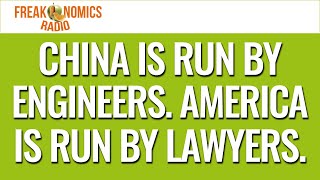
647. China Is Run by Engineers. America Is Run by Lawyers. | Freakonomics Radio
24K viewsFreakonomics Radio Network·Sep 19, 2025·With Dan Wang
DW
Related
Talks about similar things
6K views

Former Microsoft Executive on Apple’s Hidden China Problem
6K viewsa16z·Jun 18, 2025
Who’s Going To Win The Future? Dan Wang on China’s Engineers vs. America’s Lawyers | GoodFellows
1.4M viewsHoover Institution·Oct 2, 2025

Tyler Cowen Part 1
7K viewsTetragrammaton with Rick Rubin·Oct 16, 2025

China's Pharma Industry Is Booming — Here's Why | China Decode
67K viewsThe Prof G Pod·Sep 8, 2026

Morgan Housel: America Is Repeating the Exact Pattern That Destroyed Every Empire Before It
93K viewsTom Bilyeu·Jan 29, 2026