Loading
Episode
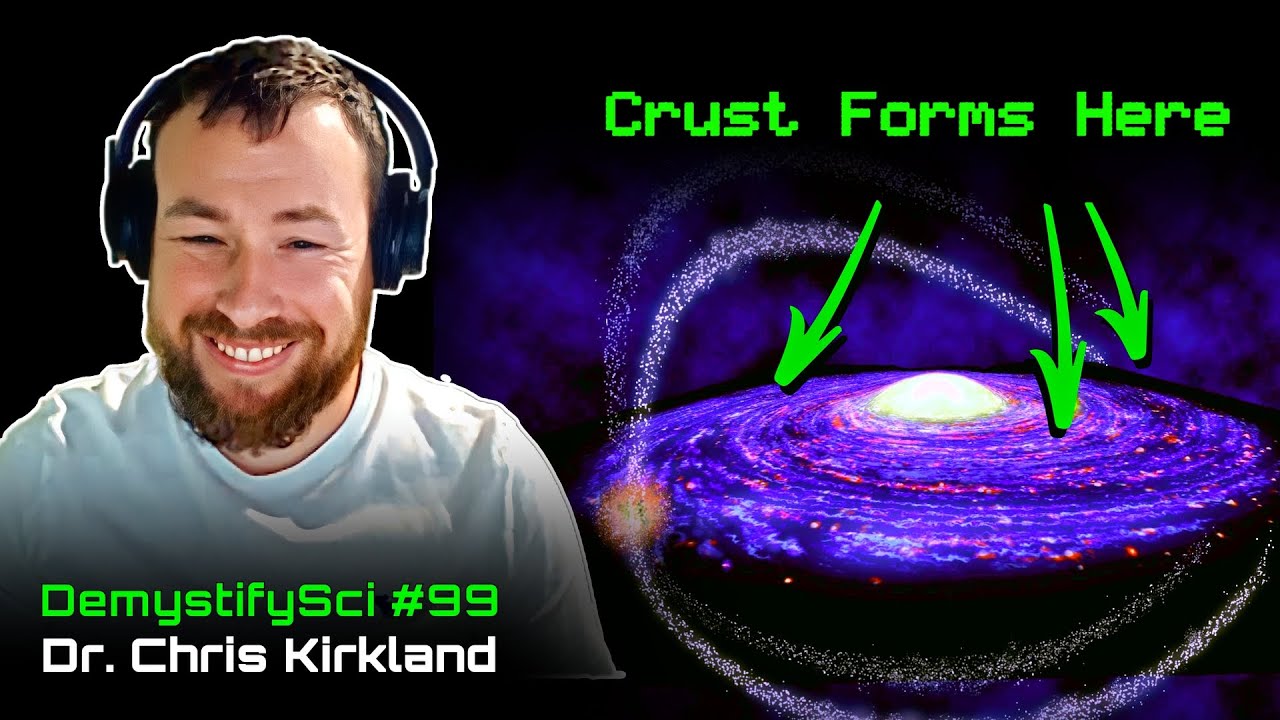
Galactic Orbits Impact Terrestrial Events - Dr. Chris Kirkland, Geologist, Curtin University
Views
690
0.1× the show’s average
Episode690
Show avg12K
Published
3y ago
Oct 17, 2022
Length
1h 31m
show avg 2h 00m
From the show
Chapters
Is Earth's crustal formation influenced by its position in the galaxy? And how would we know? It's obvious there are many celestial cycles, from the earthly ones that Milankovitch described to the orbit of the solar system through the galaxy, but how can we tie those to geological planetary cycles, like the 800 m.y. resonance of the core, the 500-300 m.y. supercontinent cycle, and the ~ 30 m.y. impact cycle? Professor Chris Kirkland and team from Australia's Curtin University have developed a zircon-based approach that they say can tease apart the cyclic secrets of crust formation. We talk radiometric dating, limits and benefits of the technique, asymptotic time horizons, and the difficulties of doing geology on a galactic scale. Support the scientific revolution with a monthly donation: https://bit.ly/3lcAasB Let us know what you think of the presentation in the comments! #geology #astronomy #physics Check our short-films channel, @DemystifySci: https://www.youtube.com/c/DemystifyingScience Join our mailing list https://bit.ly/3v3kz2S PODCAST INFO: Anastasia completed her PhD studying microbial communication at Columbia University. When not talking to brilliant people or making movies, she spends her time painting and exploring the woods. Michael Shilo also did his PhD at Columbia studying the elastic properties of molecular water. When he's not in the film studio, he's exploring sound in music. They are both freelance professors at various universities. - Blog: http://DemystifySci.com/blog - RSS: https://anchor.fm/s/2be66934/podcast/rss - Donate: https://bit.ly/3wkPqaD - Swag: https://bit.ly/2PXdC2y SOCIAL: - Discord: https://discord.gg/MJzKT8CQub - Facebook: https://www.facebook.com/groups/DemystifySci - Instagram: https://www.instagram.com/DemystifySci/ - Twitter: https://twitter.com/DemystifySci MUSIC: -Shilo Delay: https://g.co/kgs/oty671
- 0:00Go!
- 6:33How does radiometric dating work?
- 9:41A series of critical assumptions
- 15:26What are ways the clocks can get messed up?
- 23:49Why does everything converge on 4.5 billion years?
- 29:47Is everything that comes out of a volcano the same age?
- 33:30More about picking zircons
- 40:33Where are the zircons being made?
- 44:22Geology is about stories
- 50:54Galactic influence on the Early Earth?
- 57:09What were the patterns that served as the starting point?
- 59:23Were there other candidates that weren't the galaxy?
Related
Talks about similar things

Aliens, Killer Asteroid, & Black Holes Explained @CoolWorldsLab
84K viewsCamp Gagnon·Dec 6, 2024

The Magic Math Trick That Fools Everyone
536K viewsThe Rest Is Science·Dec 11, 2025

Earth's Strange Twin: the Venus Paradox - Dr. James Garvin, NASA
2K viewsThe DemystifySci Podcast·Apr 13, 2023

Master of Mainstream Cosmology - Dr. Ethan Siegel, Starts with a Bang!
992 viewsThe DemystifySci Podcast·Nov 23, 2022

Astrophysicist on 3i Atlas, NASA Moon Mission & Intelligent Life | David Kipping • 358
317K viewsJulian Dorey·Nov 21, 2025

Mindscape 276 | Gavin Schmidt on Measuring, Predicting, and Protecting Our Climate
10K viewsSean Carroll·May 20, 2024