Loading
Episode
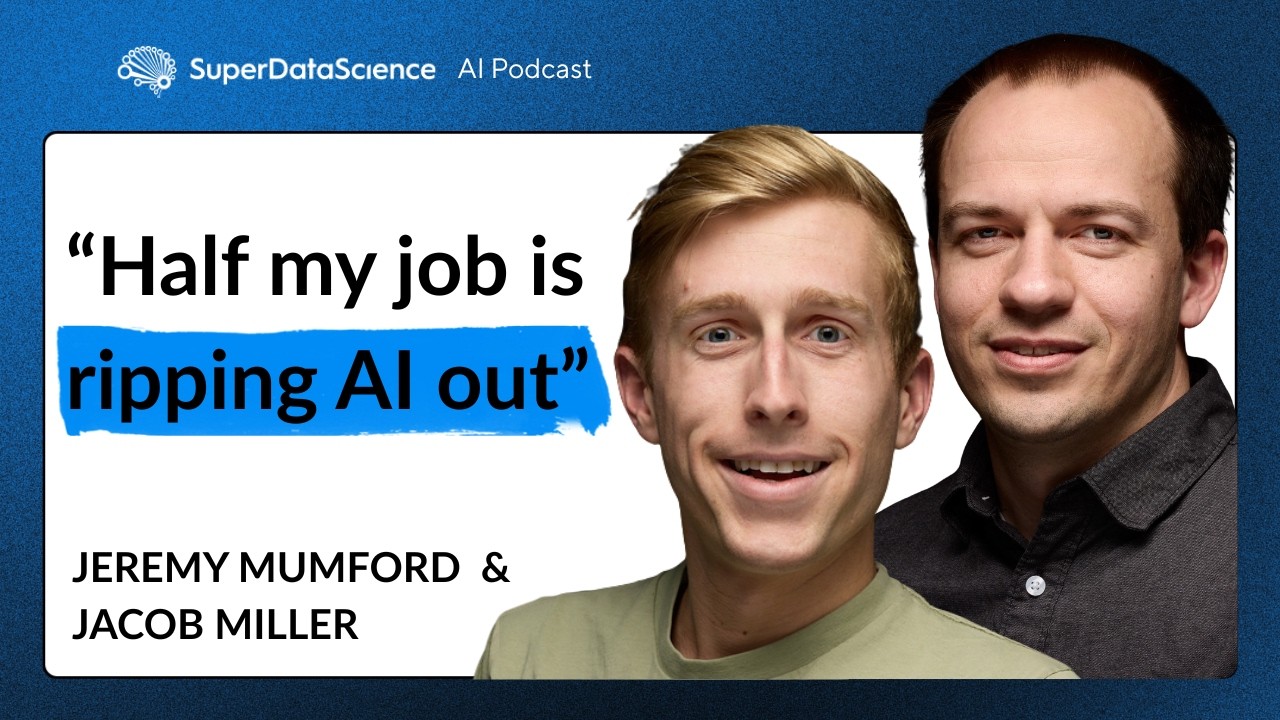
How to Build AI-First Organizations (Ep. 993 with Jacob Miller and Jeremy Mumford)

Views
25K
1.5× the show's usual
Length
1h 09m
usual ~1h 09m
From the show
Description
#AIengineering #AIpodcast #AIagents For years, AI content has come in the form of “use this library, use this tool” tutorials that age out within months. Jacob Miller and Jeremy Mumford, co-authors of the brand new Wiley book Architected Intelligence, wanted to write something different, a guide to the higher-level principles of building AI products and AI-first organizations that will still be relevant in five or ten years. In this episode, the two Pattern engineers walk @JonKrohnLearns through the core ideas of their book: why you should design products and processes so they can be executed by a human, an AI agent, or any hybrid combination; why most companies are still treating hallucinations as a model problem when they’re actually a data curation problem; why the natural progression of AI development goes skills, workflows, agents, not straight to agents; and why velocity, not models or data, is the only durable competitive advantage left. This episode is brought to you by: • Cisco: https://agntcy.org/ • Acceldata: https://acceldata.io/ • SuperDataScience: https://superdatascience.com/challenge Interested in sponsoring a SuperDataScience Podcast episode? Email natalie@superdatascience.com for sponsorship information. In this episode you will learn: • (00:00:00) Introduction • (00:10:06) The User Agnosticism Tenet • (00:20:02) The Zillow Offers parable • (00:33:52) Why data engineering is the bedrock of AI • (00:54:41) Why velocity is the only durable moat Additional materials: https://www.superdatascience.com/993
Covered · Topics
What was discussed
Related
More with these guests

Related
Talks about similar things

999: What's Left to Build When Software Is Free (with Chip Huyen)
Super Data Science: ML & AI Podcast with Jon KrohnJun 9, 2026
88% similar
37K views
The RAG Mistake Almost Every Team Is Making (with Pete Johnson)
Super Data Science: ML & AI Podcast with Jon KrohnAug 11, 2026
87% similar
17K views
Southeast Asia Joins the Data Centre Race, Alibaba Goes All-In on AI
Asia Tech Podcast OfficialAug 24, 2026
87% similar
54K views
Is Unstructured Data The Key To Successful AI Deployments?
Alex KantrowitzJun 16, 2026
86% similar
10K views
South Korea’s $597 Billion Bet on AI, Manus AI Returns to Its Independence
Asia Tech Podcast OfficialSep 3, 2026
85% similar
45K views
Why companies are becoming a series of loops | Anish Acharya (a16z)
Lenny's PodcastSep 6, 2026
85% similar
53K views