Loading
Episode
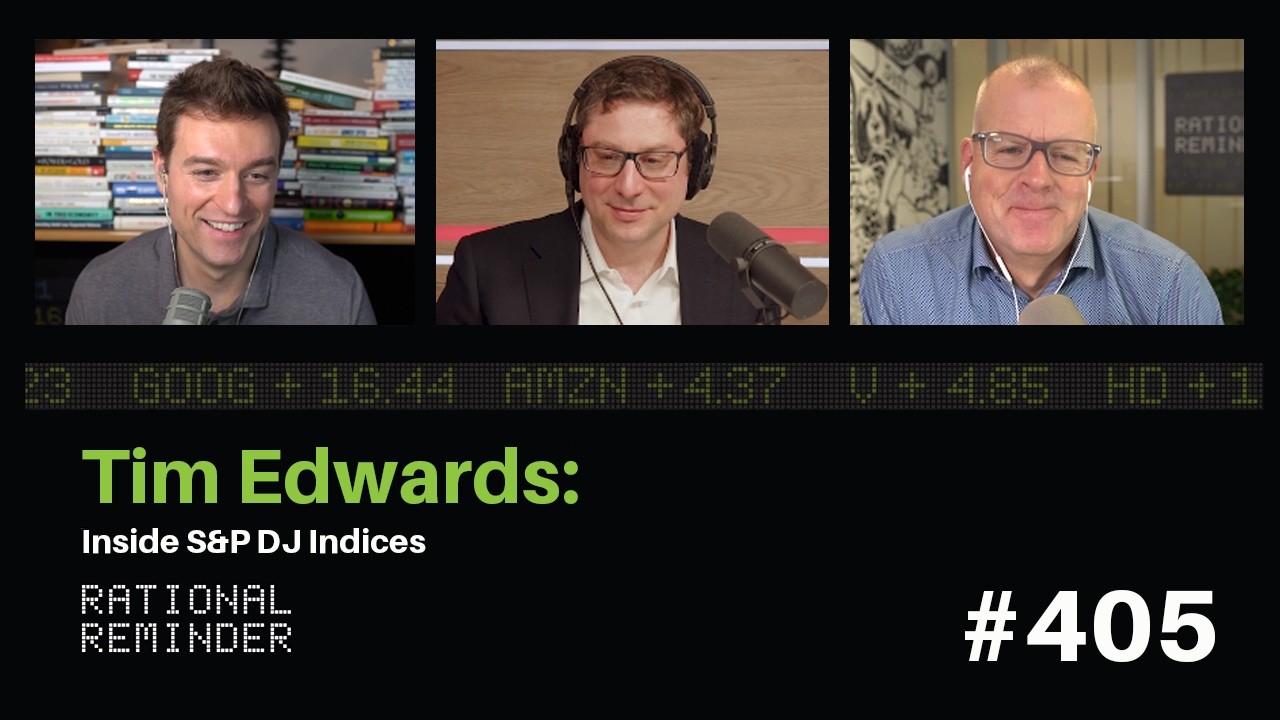
Timothy Edwards: Inside S&P DJ Indices | Rational Reminder 405
Views
7K
0.8× the show’s average
Episode7K
Show avg9K
Published
5mo ago
Apr 16, 2026
Length
1h 18m
show avg 1h 11m
From the show
Chapters
Meet with PWL Capital: https://pages.pwlcapital.com/en-ca/contact-us?utm_source=content&utm_medium=youtube&utm_campaign=rationalreminder_yt Avoid Online Scams https://pwlcapital.com/stay-safe-online/ Ben Felix or any PWL employee will never reach out to you on social media platforms or WhatsApp to give financial advice. These are scammers trying to commit fraud. What if the decades-long debate between active and passive investing wasn’t really a debate—but a data problem? In this episode, Ben Felix and Cameron Passmore are joined by Tim Edwards, Managing Director and Global Head of Index Investment Strategy at S&P Dow Jones Indices, for a deep dive into the SPIVA Scorecard—the industry’s most enduring and data-driven comparison of active versus passive investing. Tim explains how SPIVA has evolved over 25 years, why survivorship bias matters more than most investors realize, and what the data consistently shows across markets: most active funds underperform their benchmarks—especially over longer time horizons. The conversation goes beyond the headline results, exploring persistence (or lack thereof) in manager performance, why bond funds don’t escape the same fate, and whether combining active funds improves outcomes (spoiler: not really). They also tackle common critiques of indexing, including index rebalancing costs, IPO inclusion concerns, and the role of index funds in market concentration. Links: Rational Reminder on iTunes — https://itunes.apple.com/ca/podcast/the-rational-reminder-podcast/id1426530582. Rational Reminder on Instagram — https://www.instagram.com/rationalreminder/ Rational Reminder on YouTube — https://www.youtube.com/channel/ Benjamin Felix — https://pwlcapital.com/our-team/ Benjamin on X — https://x.com/benjaminfelix Benjamin on LinkedIn — https://www.linkedin.com/in/benjaminwfelix/ Cameron Passmore — https://pwlcapital.com/our-team/ Cameron on X — https://x.com/CameronPassmore
- 0:00Intro
- 3:50Describing the SPIVA Report
- 7:41How they make sure that the SPIVA data are not biased in favour of indexing
- 11:34The main points that consistently come out of the SPIVA research
- 17:42The portion of active funds that typically survive over long periods of time
- 26:00How active funds perform in bad years for the stock market
- 28:30The portion of hypothetical multi-asset portfolios constructed from active funds that outperform index benchmarks
- 32:32What has surprised Tim in a past SPIVA report
- 36:40What Tim and S&P DJI think about the paper where JFE suggests that when indexes rebalance in response to stock market composition changes, they impose an implicit performance drag
- 42:35Whether it ever make sense to create a “sleepy” index reflecting the suggestions of this research
- 44:55How the S&P DJI handle the inclusion of recent IPO shares in its indices
- 53:26How the current U.S. market concentration compares to U.S. market history
Mentioned
Names dropped
Related
More with these guests

Related
Talks about similar things

Jeff Ptak: The Simple Secret to Becoming a Better Investor
Morningstar, Inc.Aug 18, 2026
5K views

Is VEQT Costing You? (& Other Questions) | Rational Reminder 416
The Rational Reminder PodcastJul 2, 2026
18K views

The Biggest Myths in Personal Finance | Rational Reminder 423
The Rational Reminder PodcastAug 20, 2026
30K views

Index Funds Aren’t Really Passive, And Other Lessons for Building a Better Portfolio
Morningstar, Inc.Aug 25, 2026
6K views

David Booth: ‘The Markets Work Well for Everybody, Not Just the Insiders’
Morningstar, Inc.Sep 1, 2026
5K views

What SpaceX's IPO Really Tells Us About the Market | WSJ’s Take On the Week
WSJ PodcastsJun 14, 2026
9K views