Loading
Episode
What Building an AI Scientist Actually Requires Beyond Intelligence — Edward Hughes
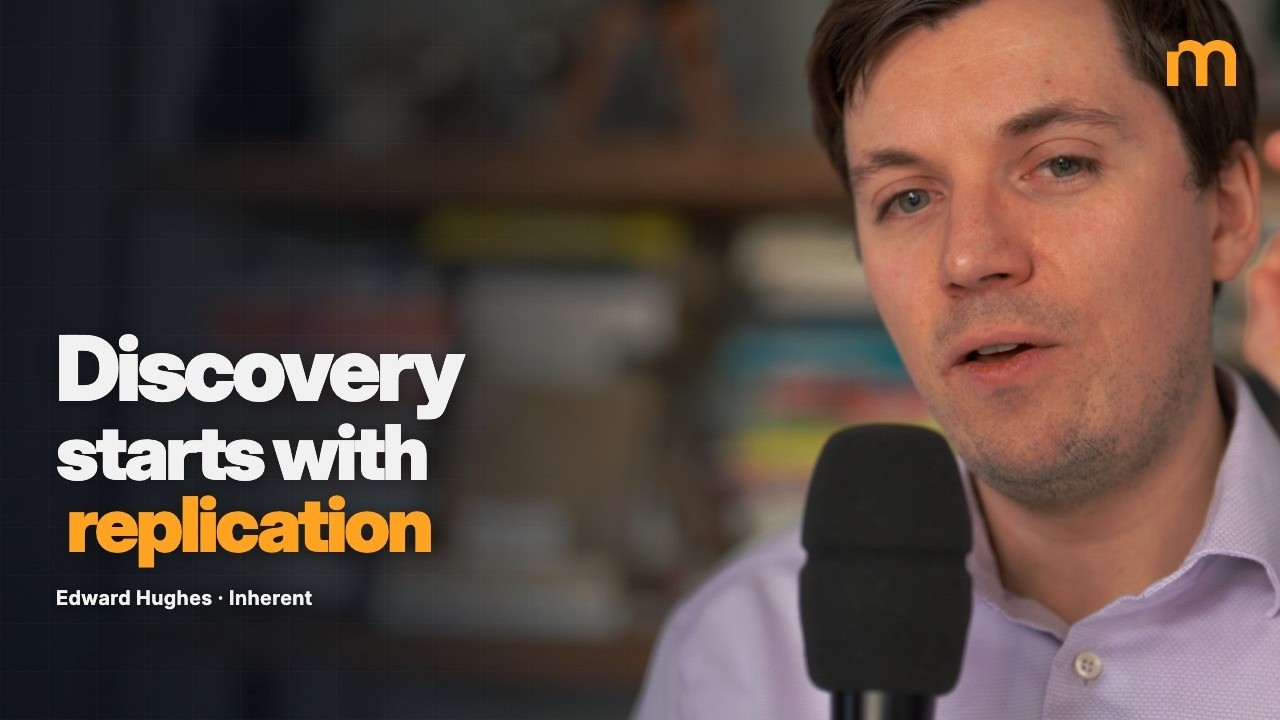

Views
21K
0.4× the show's usual
Length
2h 02m
usual ~1h 30m
From the show
Description
Can a machine learn the judgement that separates a plausible-looking result from a faithful experiment? Edward Hughes, Chief Scientist and co-founder of Inherent, joins Tim Scarfe to argue that creativity is not optimisation, and that the missing capability in AI is choosing which questions are worth asking. SPONSOR: --- Cyber Fund built the Monastery to help founders ship products that were impossible a year ago. Apply now: https://cyber.fund --- Edward makes the case that Move 37 was innovative rather than creative, and that the field, not the individual, decides what counts as a discovery. That reframing runs through Csikszentmihalyi, Deutsch and exaptation into open-endedness, where deceptive goals and imperfect world models turn out to be the point rather than the problem. The second half turns to the paper: Replica, a task space built by redacting figures from real papers, and Faraday, a 27-billion-parameter model trained to steer a frontier coding agent that then beats the frontier on held-out replications. --- TIMESTAMPS: 00:00:00 Cold open: Move 37, Faraday and collective intelligence 00:01:08 Sponsor: CyberFund 00:01:46 Inherent's $50M raise and the road from string theory 00:09:14 Three timescales of learning: weights, context, culture 00:13:47 Move 37 was innovative, not creative: the field decides 00:20:39 Creativity as satisficing: the urinal and evolution 00:25:06 Exaptation and the Tristan chord: creativity in context 00:30:56 Coherence for whom? Deutsch's hard-to-vary explanations 00:35:53 Why copying is creative: Deutsch and the constraint engineer 00:42:27 Societies of agents and the strong Moravec paradox 00:45:51 Evaluate in hindsight: from Lean proofs to climate change 00:51:56 Picbreeder, local goals and why discovery needs deception 00:57:21 Spaghetti proofs, translation layers and superhuman Go 01:00:37 Does nature compress? Naturalness and real patterns 01:07:36 Why replicate? Replica's redacted figures and Faraday 01:12:31 Faraday beats Codex, Claude and GLM 5.2 on held-out tasks 01:15:31 Replication to innovation: how the Transformer happened 01:18:26 Deep replication: what Faraday learns from Voyager and GNoME 01:23:37 Can the AI scientist cheat? Goodharting the judge 01:29:09 Inside Replica: scale-down, 8xB300 runs, per-task rubrics 01:34:11 The RL crisis: getting GRPO to work with per-turn credit 01:39:43 Weights vs harnesses: AlphaEvolve, DGM and EvoTune 01:45:45 The recursive company: agents cross a phase transition 01:50:35 Collective intelligence and the electric dynamo 01:55:46 What replaces OKRs? Incumbents and the burden of knowledge --- REFERENCES: MLST creativity article: https://archive.mlst.ai/read/why-creativity-cannot-be-interpolated organization: [00:01:47] Inherent https://inherentlabs.ai/ other: [00:20:51] Marcel Duchamp, Fountain (1917) https://www.tate.org.uk/art/artworks/duchamp-fountain-t07573 [00:28:25] The Tristan chord https://imslp.org/wiki/Tristan_und_Isolde%2C_WWV_90_(Wagner%2C_Richard) https://arxiv.org/abs/2301.07608 [00:05:41] Genie https://arxiv.org/abs/2402.15391 [00:06:05] The AI Scientist https://arxiv.org/abs/2408.06292 [00:12:13] Training AI Scientists to Replicate Research (Replica and Faraday) https://arxiv.org/abs/2608.13331 [00:25:42] Open-Endedness is Essential for ASI https://arxiv.org/abs/2406.04268 [00:50:30] MAP-Elites https://arxiv.org/abs/1504.04909 [00:50:59] OMNI: Open-endedness via Models of human Notions of Interestingness https://arxiv.org/abs/2306.01711 [00:51:01] OMNI-EPIC https://arxiv.org/abs/2405.15568 [00:53:42] Picbreeder https://pubmed.ncbi.nlm.nih.gov/20964537/ [01:17:26] Neural Machine Translation by Jointly Learning to Align and Translate https://arxiv.org/abs/1409.0473 [01:20:44] Voyager https://arxiv.org/abs/2305.16291 [01:21:57] GNoME https://www.nature.com/articles/s41586-023-06735-9 [01:34:11] DeepSeekMath https://arxiv.org/abs/2402.03300 [01:41:29] AlphaEvolve https://arxiv.org/abs/2506.13131 [01:41:53] Darwin Gödel Machine https://arxiv.org/abs/2505.22954 [01:41:56] Hyperagents https://arxiv.org/abs/2603.19461 [01:42:33] EvoTune https://arxiv.org/abs/2504.05108 [01:44:46] Evolutionary Principles in Self-Referential Learning https://people.idsia.ch/~juergen/diploma.html [01:59:33] Are Ideas Getting Harder to Find? https://www.nber.org/papers/w23782 book: [00:16:04] Creativity: Flow and the Psychology of Discovery and Invention https://search.worldcat.org/title/254487436 [00:26:22] Why Greatness Cannot Be Planned https://link.springer.com/book/10.1007/978-3-319-15524-1 [00:33:03] The Beginning of Infinity https://www.penguinrandomhouse.com/books/293575/the-beginning-of-infinity-by-david-deutsch/ [01:55:47] Laws of Knowledge https://www.penguin.co.nz/books/the-infinite-alphabet-9780241655672 --- RESCRIPT: https://app.rescript.info/session/670296ba913761d0?share=6281911cac9bdbff637f10819d4d1e5c
Covered · Topics
What was discussed
Mentioned
Names dropped in conversation
Related
Talks about similar things

How Many Narrow AIs Could Behave Like One Superintelligence - Daniel Kokotajlo and Thomas Larsen
Machine Learning Street TalkSep 8, 2026
89% similar
42K views
Chandra Sripada on How LLMs and Humans are Cognitive Cousins | Mindscape 363
Sean CarrollAug 10, 2026
86% similar
17K views
Big Technology AI Summit (full): Greg Brockman, Mike Krieger, Aaron Levie & Friends of The Podcast
Alex KantrowitzJun 26, 2026
86% similar
12K views
A Terrifying Theory of Language - Dr. Elan Barenholtz, DemystifySci #413
The DemystifySci PodcastMar 29, 2026
86% similar
24K views
When AI Discovers the Next Transformer — Robert Lange
Machine Learning Street TalkMar 13, 2026
86% similar
29K views
From Vibe Coding to Vibe Researching: OpenAI’s Mark Chen and Jakub Pachocki
a16zSep 25, 2025
87% similar
31K views