Loading

Episode
AI Is Learning at the Wrong Level of Abstraction — Matthieu Wyart

Views
20K
0.4× the show’s average
Episode20K
Show avg50K
Published
2mo ago
Aug 10, 2026
Length
1h 19m
show avg 1h 30m
From the show
Chapters
This episode is sponsored by Notion. Learn more about Notion's Developer Platform today at https://notion.com/mlst Why can deep networks discover abstractions that shallow models miss? Statistical physicist Matthieu Wyart joins Tim Scarfe to argue that the answer lies in the hidden hierarchy of data. Language and images are built from parts within parts; depth lets a network recover those coarse-grained variables and escape the curse of dimensionality. The conversation moves from jamming transitions and rough loss surfaces to Chomsky, context-free grammars and machine creativity. Wyart explains why next-token prediction can still recover compositional structure, where current systems fall short of genuine scientific invention, and why predicting latent representations rather than raw tokens could make learning far more sample-efficient. They also examine diffusion models, neural scaling laws and the limits of physics-inspired theory. The final question is on a personal note: if mistakes are the price of leaving the beaten path, how much scientific risk is worth taking? --- --- REFERENCES: person: [00:00:43] Noam Chomsky https://linguistics.mit.edu/user/chomsky/ tool: [00:02:08] Notion Developer Platform https://www.notion.com/en-gb/blog/introducing-developer-platform paper: [00:04:43] Mastering the game of Go with deep neural networks and tree search https://www.nature.com/articles/nature16961 [00:05:52] Reconciling modern machine-learning practice and the bias-variance trade-off https://arxiv.org/abs/1812.11118 [00:25:54] How Deep Neural Networks Learn Compositional Data: The Random Hierarchy Model https://arxiv.org/abs/2307.02129 [00:42:12] Efficient Estimation of Word Representations in Vector Space https://arxiv.org/abs/1301.3781 [00:52:46] Self-Supervised Learning from Images with a Joint-Embedding Predictive Architecture https://arxiv.org/abs/2301.08243 [00:52:54] Learn from your own latents and not from tokens: A sample-complexity theory https://arxiv.org/abs/2605.27734 [01:08:31] A Phase Transition in Diffusion Models Reveals the Hierarchical Nature of Data https://arxiv.org/abs/2402.16991 [01:11:39] Scaling Laws for Neural Language Models https://arxiv.org/abs/2001.08361 [01:12:17] Deriving Neural Scaling Laws from the statistics of natural language https://arxiv.org/abs/2602.07488 [01:13:34] Prediction and Entropy of Printed English https://ieeexplore.ieee.org/document/6773263 --- LINKS: Download PDF transcript: https://app.rescript.info/share/f7644cdaa86c5cc1e41e484e290f2bd4
- 0:00Can machines learn abstractions from data?
- 2:00Notion agentic workspace
- 2:49From statistical physics to machine learning
- 6:40What physics can explain about learning
- 16:37From Carnot to Chomsky bulldozer
- 21:21How deep networks recover hidden hierarchies
- 32:43Where machine creativity still falls short
- 40:48How deep nets escape the curse of dimensionality
- 52:19Why predict latents instead of tokens
- 1:02:49The sample-efficiency case for latent prediction
- 1:08:31Diffusion, scaling laws and text entropy
- 1:16:40The scientists we learn from and the mistakes we make
Related
Talks about similar things

Why More Data Cannot Replace Prior Structure - Alexander Mattick
27K viewsMachine Learning Street Talk·Sep 21, 2026

A Physicist Found the Hidden Phase Transitions in Society — Cristopher Moore
15K viewsMachine Learning Street Talk·Sep 4, 2025

AI's Research Frontier: Memory, World Models, & Planning — With Joelle Pineau
24K viewsAlex Kantrowitz·Feb 6, 2026

Why Scale Will Not Solve AGI | Vishal Misra - The a16z Show
11K viewsa16z·Mar 17, 2026
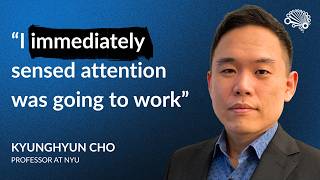
Attention Co-Inventor: AI's Next Leap Isn't More Data (Ep. 977 with Kyunghyun Cho)
124K viewsSuper Data Science: ML & AI Podcast with Jon Krohn·Mar 24, 2026

Demis Hassabis: Future of AI, Simulating Reality, Physics and Video Games | Lex Fridman Podcast #475
1.4M viewsLex Fridman Podcast·Jul 23, 2025