Loading
Episode
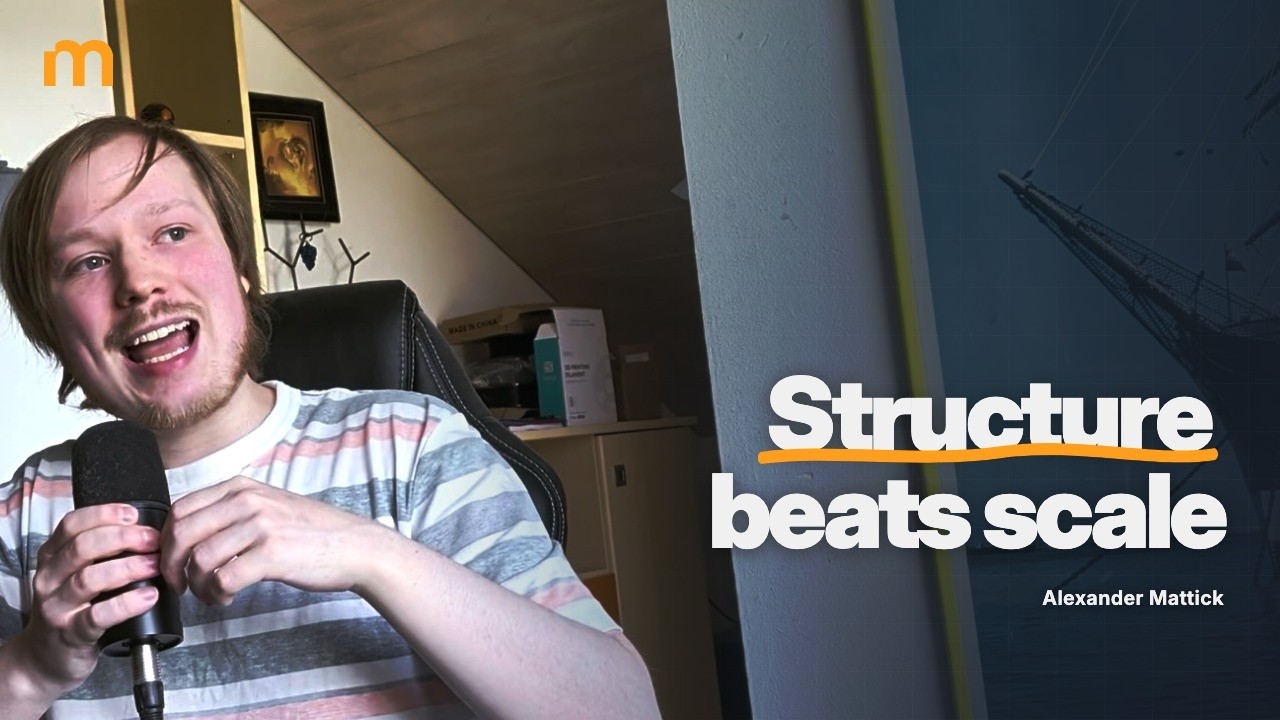
Why More Data Cannot Replace Prior Structure - Alexander Mattick

Views
15K
0.3× the show's usual
Length
2h 14m
usual ~1h 30m
From the show
Description
Alexander Mattick is a researcher at Fraunhofer IIS and a PhD researcher at the University of Technology Nuremberg (UTN), and a regular on Yannic Kilcher's Discord. He first came on MLST in 2022, after helping research the Yann LeCun and Randall Balestriero episode on interpolation. SPONSOR: --- Cyber Fund built the Monastery to help founders ship products that were impossible a year ago. Applications for Batch 1 are now open. Apply now: https://cyber.fund --- Alexander treats inference as the thread running through modern machine learning: once you have a model, what does it cost to get an answer out of it? He works through Monte Carlo, GFlowNets, energy-based models, diffusion, normalising flows and flow matching, with four short explainers he recorded himself. He is blunt about energy-based models: you can sample from them in principle, but it is rarely worth the compute. JEPA and "world model", he says, are closer to branding than to technical categories. The second half covers theories of deep learning, none of which he thinks predicts enough yet to guide practice, then reinforcement learning. Against "Reward is Enough" and the Bitter Lesson he argues that real-world information is expensive, so constraints are the cheapest way to give a system what experts already know. He also explains why prediction is not control, and why a robot demo says little about how often the robot fails. --- TIMESTAMPS: 0:00 Cold open: information is expensive 0:51 Welcome back, Alexander Mattick 1:30 Sponsor: Cyber Fund 2:08 Alexander's research background 2:50 Inference: densities, sampling and Monte Carlo 6:42 GFlowNets, energy functions and MCMC 9:45 Explainer: energy-based models 11:03 Why model a density at all? 17:30 From learned energies to flow matching 25:08 Explainers: diffusion and normalising flows 28:33 Are energy-based models generative? 33:22 JEPA, contrastive learning and collapse 41:13 Why non-language modalities need flows 44:51 Inference as search: branch and bound 49:43 Q-learning and delayed consequences 55:14 Flow matching, optimal transport, Fokker-Planck 1:00:03 Explainer: flow matching 1:01:49 AlphaFold, latents and scale versus architecture 1:07:52 Two families of deep learning theory 1:15:04 What a good theory would predict 1:23:53 The manifold hypothesis and compression 1:28:25 Is reward enough? 1:32:01 Control theory versus reinforcement learning 1:37:22 The Bitter Lesson and expensive information 1:42:08 Constrained RL: the constrained MDP toolbox 1:50:12 Creativity as constrained search 1:55:44 Reality is protean: when abstractions hold 2:00:32 What is a world model? 2:04:38 Prediction is not control 2:08:13 Robot demos, MPC and reliability --- REFERENCES: [6:55] GFlowNets (Bengio et al., 2021) https://arxiv.org/abs/2106.04399 [38:39] The empty brain (Epstein, Aeon) https://aeon.co/essays/your-brain-does-not-process-information-and-it-is-not-a-computer [38:46] Contrastive Self-Supervised Learning (Anand, 2020) https://ankeshanand.com/blog/2020/01/26/contrative-self-supervised-learning.html [38:56] LeJEPA (Balestriero and LeCun, 2025) https://arxiv.org/abs/2511.08544v3 [47:10] RL for Node Selection in Branch-and-Bound (Mattick and Mutschler, 2024) https://openreview.net/forum?id=0ez68a5UqI [56:20] Flow Matching for Generative Modeling (Lipman et al., ICLR 2023) https://arxiv.org/abs/2210.02747v2 [1:12:41] Disentangling feature and lazy training in deep neural networks https://arxiv.org/abs/1906.08034v4 [1:28:43] The World Inside Neural Networks (Goodfire) https://www.goodfire.com/research/the-world-inside-neural-networks#where-does-neural-geometry-come-from [1:31:05] Reward is enough (Silver, Singh, Precup, Sutton, 2021) https://doi.org/10.1016/j.artint.2021.103535 [1:35:12] Learning ReLU networks to high uniform accuracy is intractable (Berner et al., ICLR 2023) https://arxiv.org/abs/2205.13531v2 [1:40:20] Dota 2 with Large Scale Deep RL (OpenAI, 2019) https://arxiv.org/abs/1912.06680v1 [1:45:41] Constrained Update Projection for Safe Policy Optimization (Yang et al., 2022) https://arxiv.org/abs/2209.07089 [1:46:11] SafeMPO (ICLR 2026) https://openreview.net/forum?id=1m0EU6QXj6 [1:50:17] Why Creativity Cannot Be Interpolated (Budd and Scarfe, 2026) https://archive.mlst.ai/paper/why-creativity-cannot-be-interpolated/ [1:51:39] Invalid Action Masking (Huang and Ontañón) https://arxiv.org/abs/2006.14171 [2:00:04] Probability Theory: The Logic of Science (Jaynes, 2003) https://www.cambridge.org/core/books/probability-theory/9CA08E224FF30123304E6D8935CF1A99 [2:01:53] Training Agents Inside of Scalable World Models (Hafner et al., 2025) https://arxiv.org/abs/2509.24527v1 [2:03:43] World Models (Ha and Schmidhuber, 2018) https://arxiv.org/abs/1803.10122v4 --- RESCRIPT https://app.rescript.info/share/aa6fffbf30555291e784b74125340034
Covered · Topics
What was discussed
Mentioned
Names dropped in conversation
Related
More with these guests

Related
Talks about similar things

What Building an AI Scientist Actually Requires Beyond Intelligence — Edward Hughes
Machine Learning Street TalkSep 11, 2026
86% similar
21K views
AI Is Learning at the Wrong Level of Abstraction — Matthieu Wyart
Machine Learning Street TalkAug 10, 2026
86% similar
19K views
913: LLM Pre-Training and Post-Training 101 — with Julien Launay
Super Data Science: ML & AI Podcast with Jon KrohnAug 12, 2025
86% similar
47K views
Building an AI Physicist: ChatGPT Co-Creator’s Next Venture
a16zSep 30, 2025
85% similar
22K views
919: Hopes and Fears of AGI, with All-Time Bestselling ML Author Aurélien Géron
Super Data Science: ML & AI Podcast with Jon KrohnSep 2, 2025
85% similar
89K views
From Vibe Coding to Vibe Researching: OpenAI’s Mark Chen and Jakub Pachocki
a16zSep 25, 2025
85% similar
31K views