Loading
Episode
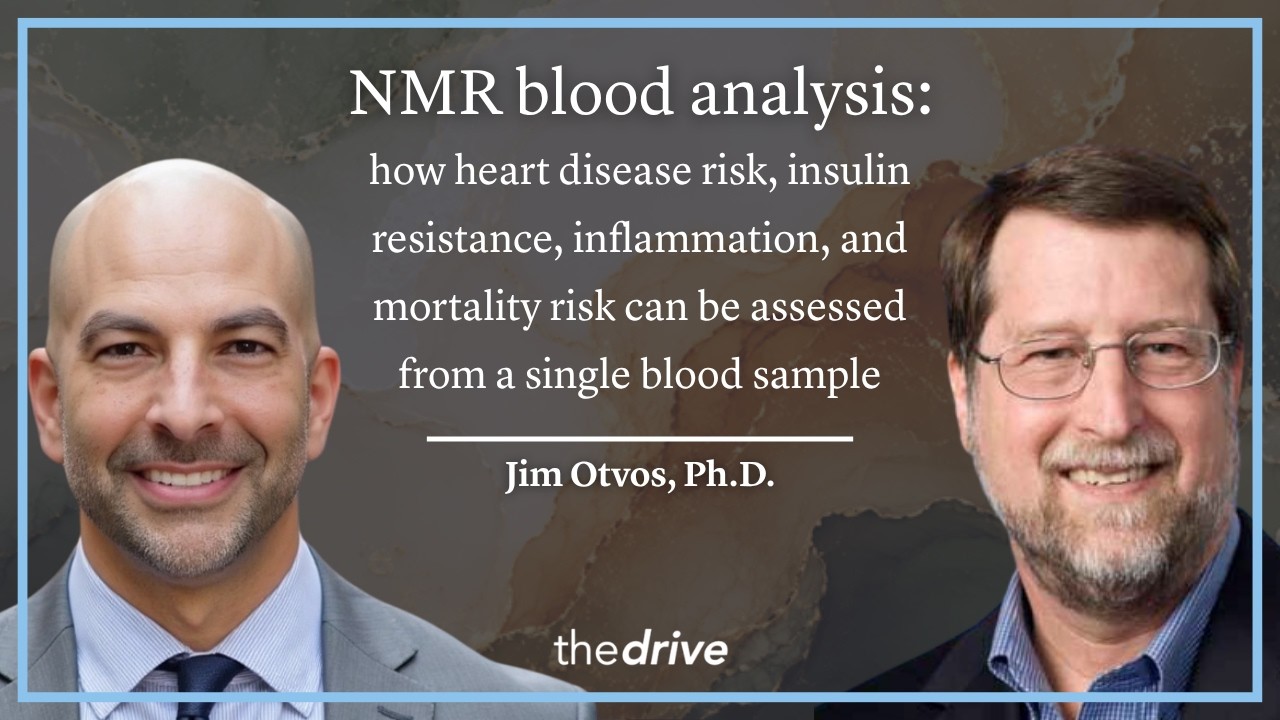
402 ‒ NMR blood analysis: how mortality risk and more can be assessed from a single blood sample

From the show
Description
In this episode, Jim Otvos, Ph.D., recounts the unlikely story of transforming a flawed cancer test into a new way of measuring lipoproteins, explains what standard cholesterol tests can miss and why LDL-P and apoB can inform treatment decisions beyond LDL cholesterol alone, and dispels the misconception that large, “fluffy” LDL particles are benign. View show notes here: https://peterattiamd.com/jimotvos/ Become a member to receive exclusive content: https://peterattiamd.com/subscribe/ Sign up to receive Peter's email newsletter: https://peterattiamd.com/newsletter/ 0:00:00 - Intro 0:00:11 - How investigating a flawed 1986 cancer test led to the development of NMR (nuclear magnetic resonance) lipoprotein testing 0:12:50 - How standard lipid panels measure cholesterol and triglycerides, and why LDL cholesterol is estimated rather than directly measured 0:18:16 - How NMR spectroscopy measures lipoprotein particle size and concentration 0:26:52 - Why LDL particle number matters more than particle size, and why large, “fluffy” LDL is not benign 0:35:02 - Discordance between LDL cholesterol and LDL particle number: which measure better reflects cardiovascular risk? 0:44:27 - How metabolic syndrome and lipid-lowering treatment contribute to the discordance between LDL-C and LDL-P, and the value of particle number for managing risk 0:50:32 - Using the NMR-derived LP-IR score to detect insulin resistance and predict type 2 diabetes before glucose rises 1:05:04 - The development, commercialization, and uncertain future of the Vantera NMR Analyzer and NMR-based diagnostics 1:17:00 - The analytical efficiency of NMR testing and the data-driven development of the Metabolic Vulnerability Index (MVX) 1:26:54 - GlycA as an NMR-derived marker of systemic inflammation: its discovery, biological basis, and advantages over hs-CRP 1:35:42 - Developing the Metabolic Vulnerability Index (MVX): biomarkers of inflammation, malnutrition, muscle wasting, and mortality risk 1:46:00 - What MVX can tell us about longevity and mortality 1:52:25 - How MVX may reveal metabolic frailty and predict premature mortality decades in advance in young, healthy adults 2:02:17 - Potential applications of MVX for predicting treatment response, surgical resilience, and clinical trial outcomes, and the barriers to broader use 2:10:16 - ApoB versus LDL-P: their clinical similarities, the additional information provided by NMR, and barriers to broader adoption 2:16:01 - Interpreting the effects of the CETP inhibitor, obicetrapib, on LDL-P, apoB, and small HDL particles 2:23:53 - The future of NMR diagnostics and MVX: translating scientific potential into broader clinical use -------- About: The Peter Attia Drive is a deep-dive podcast focusing on maximizing longevity, and all that goes into that from physical to cognitive to emotional health. With over 90 million episodes downloaded, it features topics including exercise, nutritional biochemistry, cardiovascular disease, Alzheimer’s disease, cancer, mental health, and much more. Peter Attia is the founder of Early Medical, a medical practice that applies the principles of Medicine 3.0 to patients with the goal of lengthening their lifespan and simultaneously improving their healthspan. Learn more: https://peterattiamd.com Connect with Peter on: Facebook: http://bit.ly/PeterAttiaMDFB Twitter: http://bit.ly/PeterAttiaMDTW Instagram: http://bit.ly/PeterAttiaMDIG Subscribe to The Drive: Apple Podcast: http://bit.ly/TheDriveApplePodcasts Overcast: http://bit.ly/TheDriveOvercast Spotify: http://bit.ly/TheDriveSpotify Google Podcasts: http://bit.ly/TheDriveGoogle Disclaimer: This podcast is for general informational purposes only and does not constitute the practice of medicine, nursing, or other professional healthcare services, including the giving of medical advice. No doctor-patient relationship is formed. The use of this information and the materials linked to this podcast is at the user's own risk. The content on this podcast is not intended to be a substitute for professional medical advice, diagnosis, or treatment. Users should not disregard or delay in obtaining medical advice for any medical condition they have, and they should seek the assistance of their healthcare professionals for any such conditions. I take conflicts of interest very seriously. For all of my disclosures and the companies I invest in or advise, please visit my website where I keep an up-to-date and active list of such companies. For a full list of our registered and unregistered trademarks, trade names, and service marks, please review our Terms of Use: https://peterattiamd.com/terms-of-use/
Covered · Topics
What was discussed
Related
Talks about similar things
407 ‒ Preventing cardiovascular and Alzheimer’s disease: lowering LDL early, APOE4, and more
The Peter Attia DriveSep 14, 2026
87% similar
55K views
#21 – Tom Dayspring, M.D., FACP, FNLA – Part II of V: Lipid metrics and cholesterol regulation
The Peter Attia DriveJan 1, 2020
88% similar
16K views
Carnivore MD vs Harvard Heart Doctor: Seed Oils are Actually GOOD For You
Danny JonesSep 26, 2025
85% similar
173K views
Dr. Peter Attia on Mastering Longevity – Insights on Cancer Prevention, Heart Disease, and Aging
FoundMyFitnessDec 27, 2023
86% similar
641K views
Dr. Ronald Krauss on LDL Cholesterol, Particle Size, Heart Disease & Atherogenic Dyslipidemia
FoundMyFitnessOct 16, 2015
85% similar
271K views
The #1 Killer - and they’re treating it ALL wrong | Ep173
The Dr. Gundry PodcastSep 14, 2021
84% similar
1.2M views